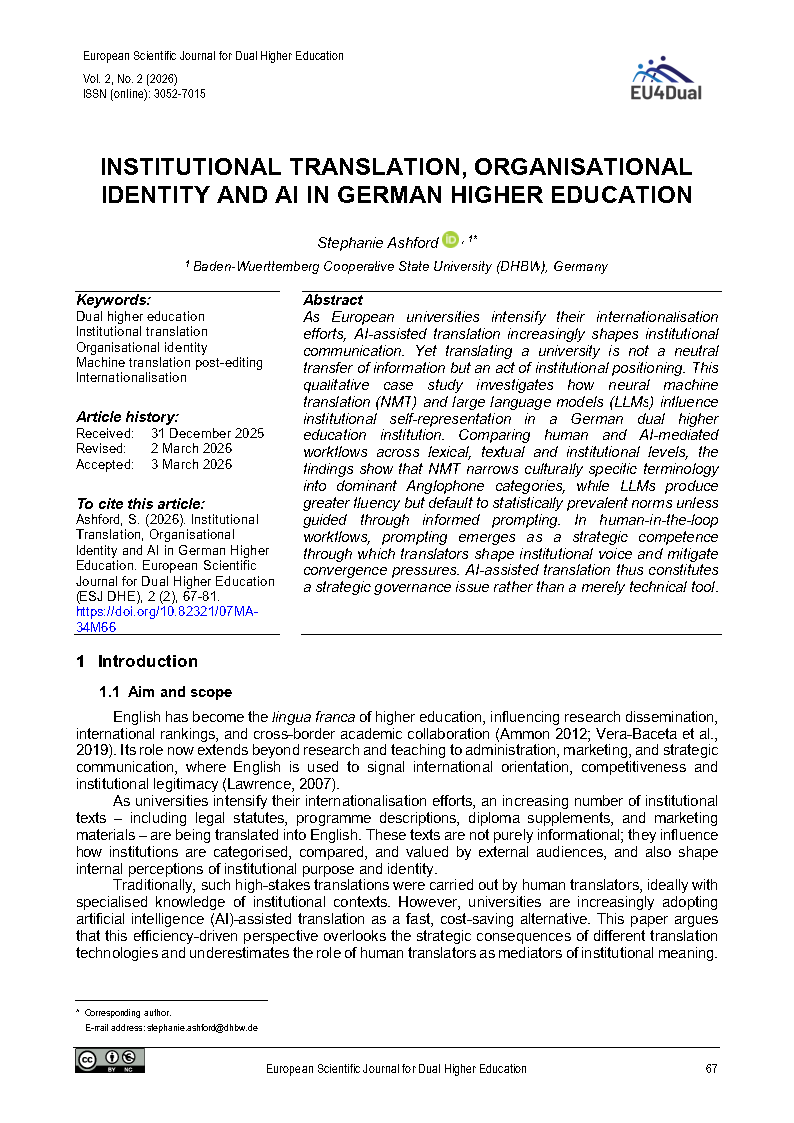
Institutional Translation, Organisational Identity and AI in German Higher Education
DOI:
https://doi.org/10.82321/07MA-34M66Keywords:
Dual higher education, Institutional translation, Organisational identity, Machine translation post-editing, InternationalisationAbstract
As European universities intensify their internationalisation efforts, AI-assisted translation increasingly shapes institutional communication. Yet translating a university is not a neutral transfer of information but an act of institutional positioning. This qualitative case study investigates how neural machine translation (NMT) and large language models (LLMs) influence institutional self-representation in a German dual higher education institution. Comparing human and AI-mediated workflows across lexical, textual and institutional levels, the findings show that NMT narrows culturally specific terminology into dominant Anglophone categories, while LLMs produce greater fluency but default to statistically prevalent norms unless guided through informed prompting. In human-in-the-loop workflows, prompting emerges as a strategic competence through which translators shape institutional voice and mitigate convergence pressures. AI-assisted translation thus constitutes a strategic governance issue rather than a merely technical tool.
Downloads
Published
Issue
Section
License
Copyright (c) 2026 Stephanie Ashford

This work is licensed under a Creative Commons Attribution-NonCommercial 4.0 International License.