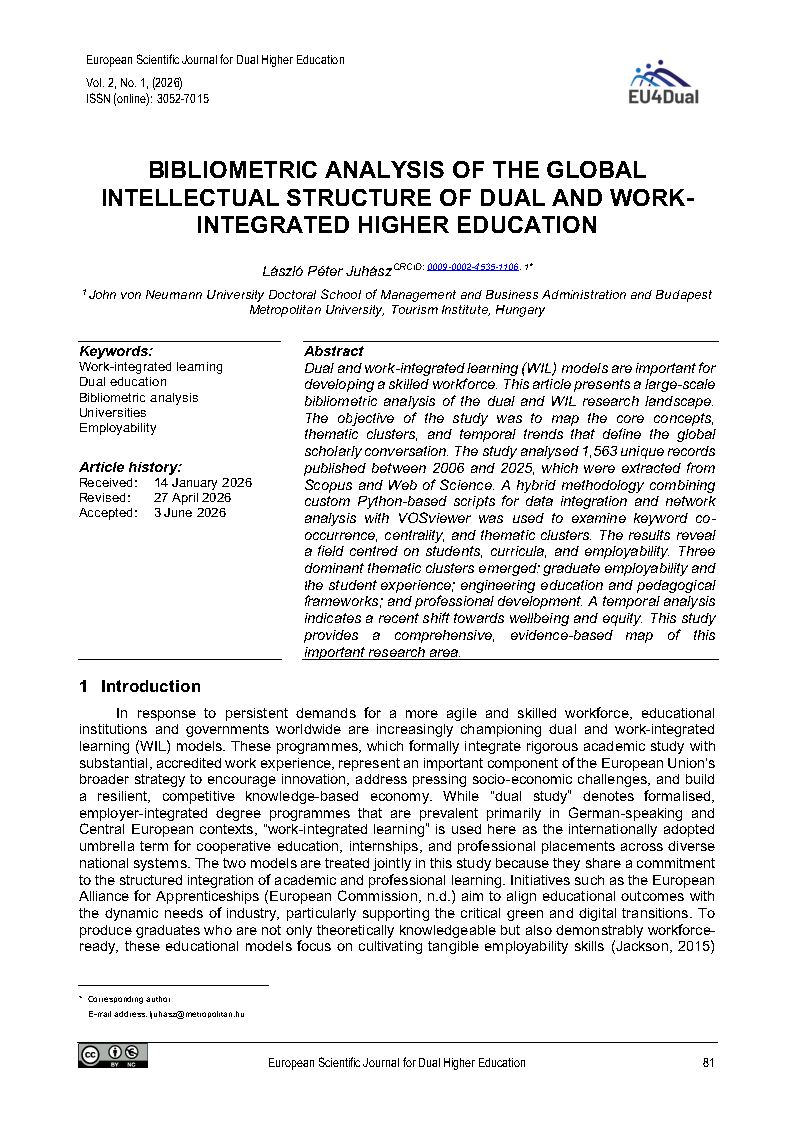
Bibliometric Analysis of the Global Intellectual Structure of Dual and Work-Integrated Higher Education
DOI:
https://doi.org/10.82321/01dhbw-24m68Keywords:
Work-integrated learning, Dual education, Bibliometric analysis, Universities, EmployabilityAbstract
Dual and work-integrated learning (WIL) models are important for developing a skilled workforce. This article presents a large-scale bibliometric analysis of the dual and WIL research landscape. The objective of the study was to map the core concepts, thematic clusters, and temporal trends that define the global scholarly conversation. The study analysed 1,563 unique records published between 2006 and 2025, which were extracted from Scopus and Web of Science. A hybrid methodology combining custom Python-based scripts for data integration and network analysis with VOSviewer was used to examine keyword co-occurrence, centrality, and thematic clusters. The results reveal a field centred on students, curricula, and employability. Three dominant thematic clusters emerged: graduate employability and the student experience; engineering education and pedagogical frameworks; and professional development. A temporal analysis indicates a recent shift towards wellbeing and equity. This study provides a comprehensive, evidence-based map of this important research area.
Downloads
Published
Issue
Section
License
Copyright (c) 2026 László Péter Juhász

This work is licensed under a Creative Commons Attribution-NonCommercial 4.0 International License.